
How Do VAV Dampers Work?
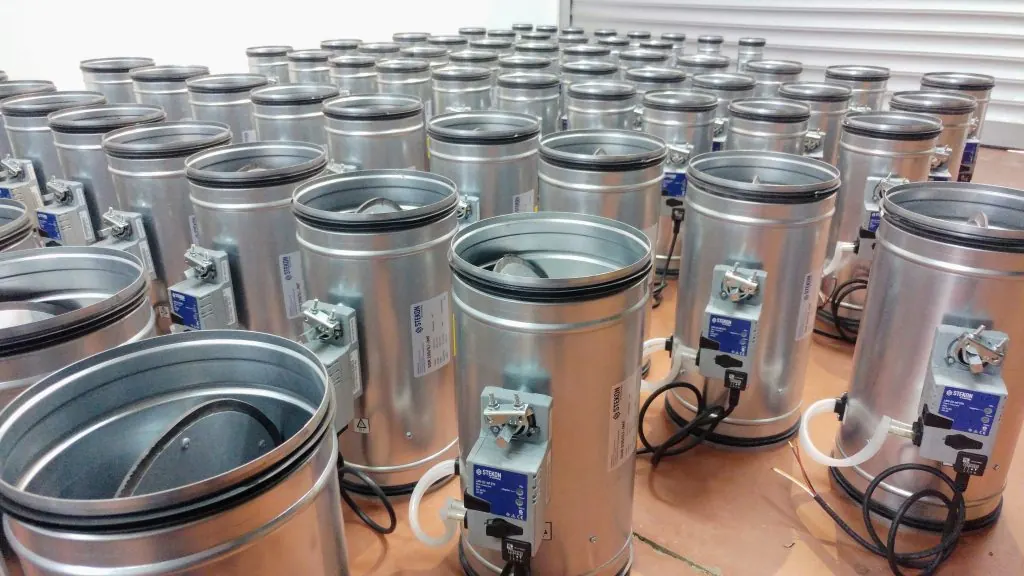
HOW DO VAV TERMINAL UNITS WORK?
All-air systems are systems where temperature control of the environment is provided solely by conditioned air supplied from a central air conditioning system. In all-air system applications, there are several ways to meet the heating and/or cooling load in a space.
For the air supplied to the space:
- Changing the flow rate while keeping the temperature constant,
- Changing the temperature while keeping the flow rate constant,
- Changing both the temperature and the flow rate.
In cases 1 and 3, VAV must be used in the system, and in case 2, CAV must be used in the system.
So, What is a VAV Unit?
VAV = Variable Air Volume
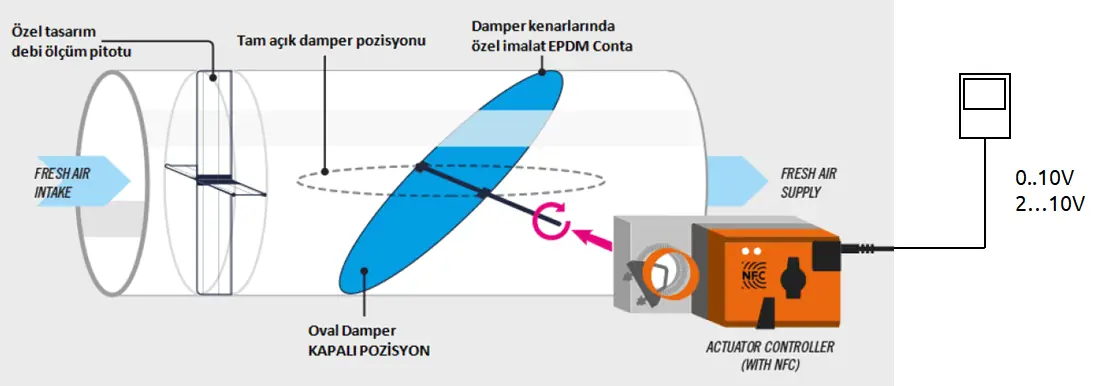
VAV units are devices that adjust the flow rate of conditioned air supplied to a room, independently of pressure, based on temperature data received from the room thermostat. In other words, these units are devices that provide ambient temperature control by changing the amount of heated/cooled air supplied to a space, according to a signal received from a thermostat or a building automation system (BMS).
In some cases, they are used not for temperature control, but to maintain a set positive/negative pressure value for the room.
Two modes of operation can be set:
- Operation in the 0…10V range (0V minimum flow, 10V maximum flow)
- Operation in the 2…10V range (0-2V full shut-off, 2V minimum flow, 10V maximum flow)
Where are VAV Dampers used?
- They are used in living spaces where separate temperature control is desired due to different heating requirements, for example, in open-plan offices.
- They are used in areas where pressure control is required, such as clean rooms, hospital rooms, and special process manufacturing facilities.
- Due to the variable pressure values created by the saturation levels of HEPA filters, they are used before HEPA filter boxes to continuously provide the desired flow rate independently of pressure.
- They are used in fresh air supply systems to maintain indoor air quality at the desired level, depending on the carbon dioxide value of the environment.
- They are used in constant flow rate systems that can be controlled via automation.
What criteria should be considered when selecting a VAV Damper?
- In VAV damper selection, the flow rate is determined according to the cooling load in the most critical situation. This is your maximum flow rate (Vmax). On the other hand, the minimum fresh air quantity to be determined for the environment it serves (depending on the number of people) is your minimum flow rate (Vmin).
- When selecting a VAV unit based on these values, it is recommended that the cross-sectional velocity at maximum air flow rate should be between 5 m/s and 8 m/s.
- If you select at very low speeds, the VAV damper will generally operate inefficiently at its lowest position, and the noise problem may even increase.
- If you select at very high speeds, in addition to the noise problem, you will have no limit to increase the flow rate on the device if more flow is required in the future.
- The “device pressure difference” you determine during selection is the difference between the pressure before the VAV and the pressure after the VAV. Generally, it is taken as 150 – 200 Pa. The higher this difference, the more noise the device will produce to pass the same flow rate. For better sound values, a low-pressure duct system should be designed.
- After appropriate cross-sections are selected according to the flow rate, noise values should be checked. Sound pressure values are determined by applying system attenuation according to VDI 2081 to the sound power values. Based on these values, the procedures under the heading “Acoustic Performance” are applied.
- The communication protocol of the actuator on the VAV damper (MF, MPbus, Modbus, Lonworks, Bacnet) must be determined in advance, and the VAV control unit must be selected accordingly.
- For selection checks on your project, mutual consultation with the manufacturer (STEKON A.Ş.) should be ensured.
What makes the BEST and MOST ACCURATE VAV Damper?
We can examine this under three headings.
a. Measurement Accuracy
A good VAV unit's error margin between the determined flow rate and the actual flow rate should not exceed 5%. The reason for this is that errors in flow measurement require higher fan power due to the necessity of providing more airflow. For example, according to the fan law, a 40% error rate in flow measurement can lead to a 170% fan power loss. In addition, the extra heating and cooling costs of the additional air supplied should also be considered.
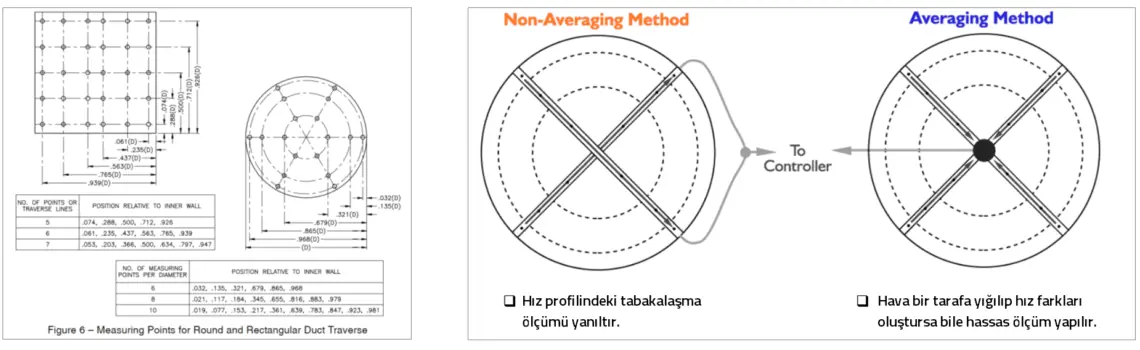
The design of the VAV unit's measurement probe is the most important factor in measurement accuracy. This probe must both read pressure differences as high as possible and have a measurement system that is minimally affected by air turbulence.
b. Acoustic Performance
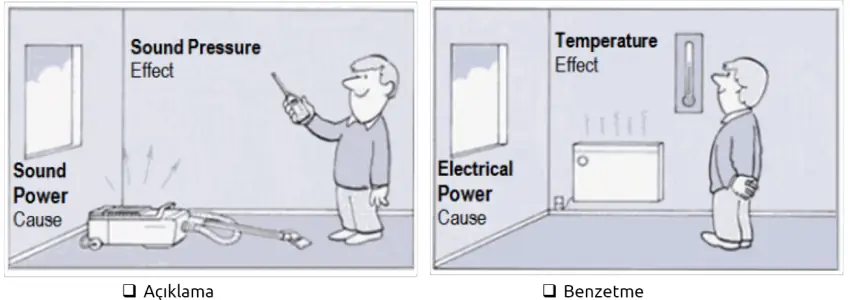
Before delving into acoustics in VAV dampers, it is necessary to address the differences between Sound Power and Sound Pressure, which are stated in catalogs and apply to all devices.
Sound Power (Lw) is the sound energy emitted by a sound source.
Sound Pressure (Lp) is the audible state of the sound spectrum produced by a specific source, its sound power, at a certain distance and after a certain attenuation time, in an environment where the source's location is precisely determined. In other words, sound pressure is the audible state of the sound power value.
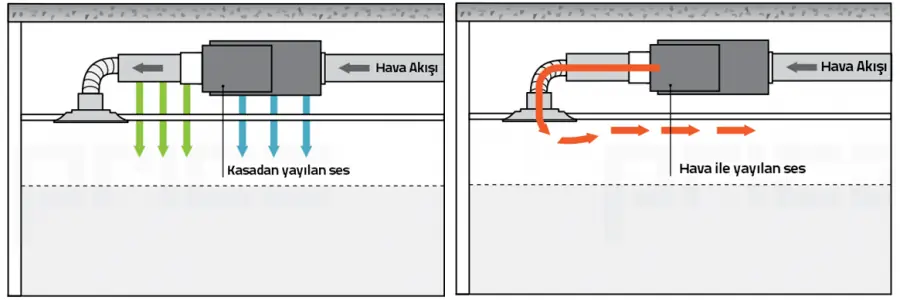
In a VAV terminal unit, there are two different sound paths:
1. Sound radiated from the casing is noise generated by the pressure created by the damper in the device and spreads from the casing to the suspended ceiling. If it is thought to exceed a critical value, an acoustic insulation option over the device should be considered.
2. Sound radiated with the air is noise created in the device that travels with the conveyed air and spreads into the environment through the diffuser/grille openings where the air exits. If it is thought to exceed a critical value, a silencer option after the device should be considered.
c. Airtightness
Since VAV dampers are also used in critical environments, their airtightness in the fully closed position must be very good to prevent the passage of infection or other critical solvent-containing air to other environments.
Furthermore, if airtightness is insufficient, leaks occurring during full closure create unnecessary fan and heating/cooling costs.
Casing and blade airtightness values are determined according to EN 1751. These values should be obtained from the VAV manufacturer and checked.

For more detailed information about STEKON VAV Terminal Units:

For more information and project solution support, contact us:
Phone: 0216 4700070 or 0533 7323738
Ender Bilgin