Thermal Element Swirl Diffuser: Autonomous Thermal Control and Thermal Actuator Technology

Thermal Element Swirl Diffuser: Autonomous Thermal Control and Thermal Actuator Technology
In today's modern architectural structures, especially in commercial buildings, sustainability and energy efficiency have evolved from being a preference to a fundamental design imperative. While HVAC for large volume spaces accounts for nearly half of a building's total energy consumption, engineering success is measured not only by generating energy but also by “distributing” this energy within the space at the right time, in the right direction, and with minimal loss. Autonomous control systems, which revolutionize HVAC strategies, step in at this point, offering an intelligent solution that optimizes air distribution without the need for an external energy source.
What is Thermal Actuator Technology?
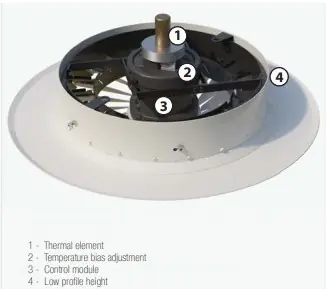
Diffusers with thermal actuators are autonomous (self-acting) systems that operate entirely on the principle of physical expansion, without requiring an external energy source. At the heart of this technology is a thermal wax element that responds with millimeter precision to changes in supply air temperature.
The system senses only the temperature of the supplied air, without needing any electrical connection, sensor cabling, or central automation (BMS) signal. When the air is cold, the wax element contracts, directing the flow horizontally. When the air warms up, the element expands, moving the internal mechanism downwards and pushing the warm air vertically towards the floor.
Why Should Thermal Actuator Systems Be Preferred?
Integrating this technology into a project is not just a technical choice; it is a strategic investment that minimizes operating costs and maximizes user comfort:
- Zero Energy Consumption and Carbon Neutral Operation: The actuator derives its kinetic energy entirely from the thermal power of the supply air, not from an external source. Throughout the building's lifespan, there are no additional energy costs for this control mechanism, directly contributing to a reduced carbon footprint.
- Low Initial Investment and Maintenance Costs: The costs associated with meters of cable trays, complex wiring, and automation (BMS) points, which are mandatory for electric actuators, are completely eliminated. Since it contains no electronic circuits or motors that could malfunction, it requires no periodic maintenance during operation.
- Autonomous Operation: Requires no electrical calibration or on-site testing. Once installed, the product begins autonomous operation as soon as supply air is provided, significantly shortening commissioning time.
- Elimination of Thermal Stratification: Prevents heated air from being trapped at the ceiling due to its physical properties. It maximizes heating efficiency by delivering energy directly to the occupied zone where it is needed.
Invisible Barrier in Energy Distribution: Thermal Stratification
In high-ceiling spaces (exhibition halls, terminals, logistics centers), the biggest physical obstacle to comfort is the tendency of heated air to rise. Traditional diffusers, in heating mode, trap warm air at the ceiling, leading to significant energy waste. In cooling mode, the uncontrolled drop of cold air, whose density increases, directly compromises user comfort.
Thermal actuator technology provides an autonomous response to seasonal transitions by changing the discharge direction according to the supply air temperature. Thanks to this technology:
- In Heating Mode: Warm air is directed towards the floor, forming a vertical swirl cone.
- In Cooling Mode: Cold air is distributed horizontally along the ceiling, ensuring homogeneous mixing (induction) within the space and preventing the air from dropping abruptly onto occupants.
Distinguishing Parameters in Technical Design: Helical Geometry
Simply directing air is not enough for air distribution; the true efficiency of the system is determined by the diffuser's aerodynamic structure. Swirl diffusers with helical geometry offer a flow physics that sets them apart from standard grilles:
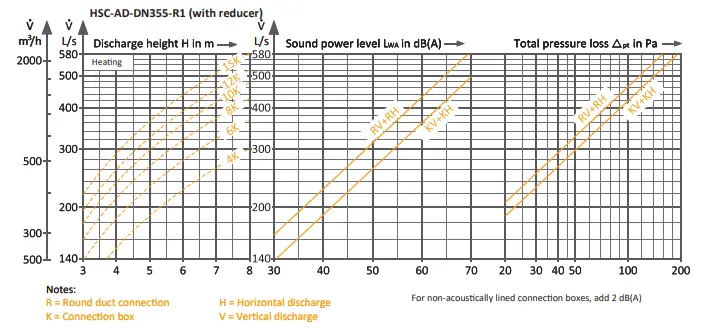
- Constant Pressure Characteristic: In advanced designs, even when the discharge direction changes from horizontal to vertical, the system pressure loss remains constant. This feature ensures that adjustments made during seasonal transitions do not disrupt the duct pressure balance and prevents fan surging.
- High Induction and ADPI Success: The swirl discharge characteristic of the diffuser ensures very intense mixing of the supply air with the room air (high induction). This intense mixing minimizes temperature differences within seconds, pushing the Air Distribution Performance Index (ADPI) above 90% and ensuring no stagnant or cold spots remain in the space.
- Role of Helical Vane Structure: The helical structure, which steepens towards the center of the vanes, prevents the discharge pattern from breaking even if the air volume decreases, ensuring continuous comfort. Furthermore, this special structure enhances the ability of warm air to penetrate the floor in heating mode.
- Acoustic Comfort: The curved leading edge design of the vanes allows air to be discharged without turbulence, minimizing both sound power level and pressure loss.
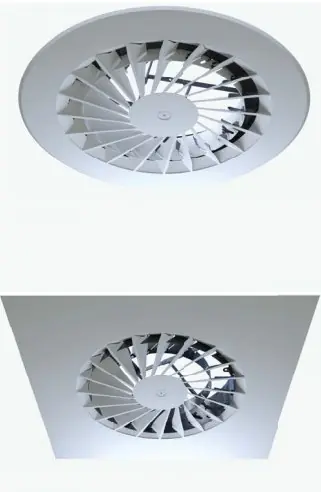
Smart Air Distribution in High-Ceiling Areas: SMARTEMP HSC-AD Series
The HSC-AD Helical Swirl Diffuser, which combines all these technological advantages in a single unit, optimizes air distribution parameters to provide a high-performance solution that addresses the most challenging architectural and technical demands:
- Multi-Directional Discharge Control (Horizontal-Vertical): The patented helical movement mechanism continuously adjusts the air flow direction from horizontal to vertical without creating any pressure loss. This flexibility provides a horizontal spread that prevents air drop in cooling mode, and a powerful vertical throw that penetrates from high ceilings to the floor in heating mode.
- Mounting Range: It offers stable performance at all ceiling heights from 2.5 meters to 10 meters, maintaining ideal discharge characteristics in both low-temperature cooling and high-temperature heating modes. This wide range allows the diffuser to be flexibly used in various spaces, from lobbies to industrial facilities.
- Precise On-Site Calibration: The manual “bias” adjustment on the thermal wax-bulb actuator allows the heating mode transition temperature threshold to be easily set on-site between 22°C and 30°C.
- Constant Pressure Adjustment Mechanism: The helically moving guide ring and its 20 adjustable vanes maintain constant system pressure loss while changing air direction, preserving fan efficiency and system balance.
- Condensation Inhibitor (Sweat Inhibitor) Design: With the optional “insulated central part” offered for high-humidity areas or applications with intense outdoor air infiltration, the risk of sweating and condensation on the diffuser surface is minimized.
- Modular Capacity and Design Flexibility: The wide range of sizes from DN250 to DN710 offers the possibility to change the airflow rate by approximately 50% within the same device size. Additionally, optional reducer options maintain ideal discharge performance even for low flow rate needs, making system design 30% more efficient.
- Architectural and Control Flexibility: With round or square face options, it perfectly adapts to architectural designs; and with manual, electric, or thermal actuator options, it responds to all types of automation configurations.
The preference for thermal actuator systems in the HVAC strategies of commercial buildings provides a critical advantage for sustainable building management due to their maintenance-free operational structure and superior thermal comfort. Through correct engineering decisions and high-performance air distribution solutions like the HSC-AD, energy saving becomes a permanent and standard performance parameter of the project, rather than just a goal to be achieved.