
Stekon Trench Heater
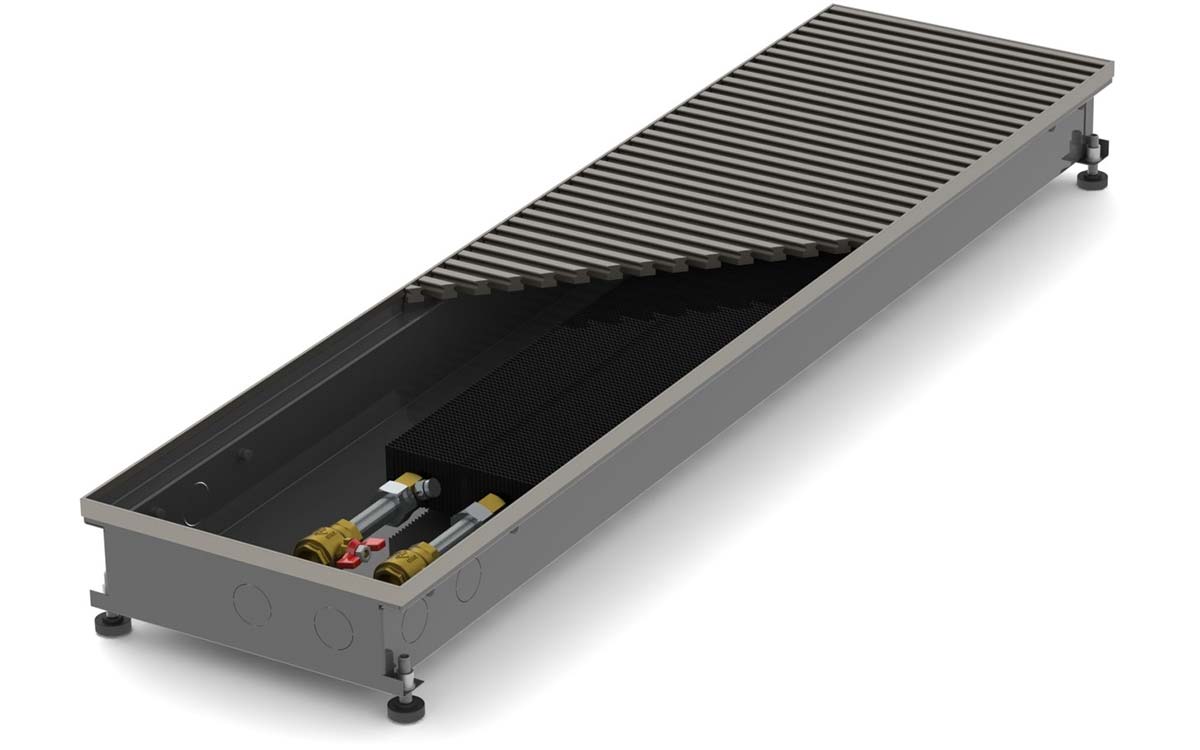
SC80 Convector - without fan
Product Details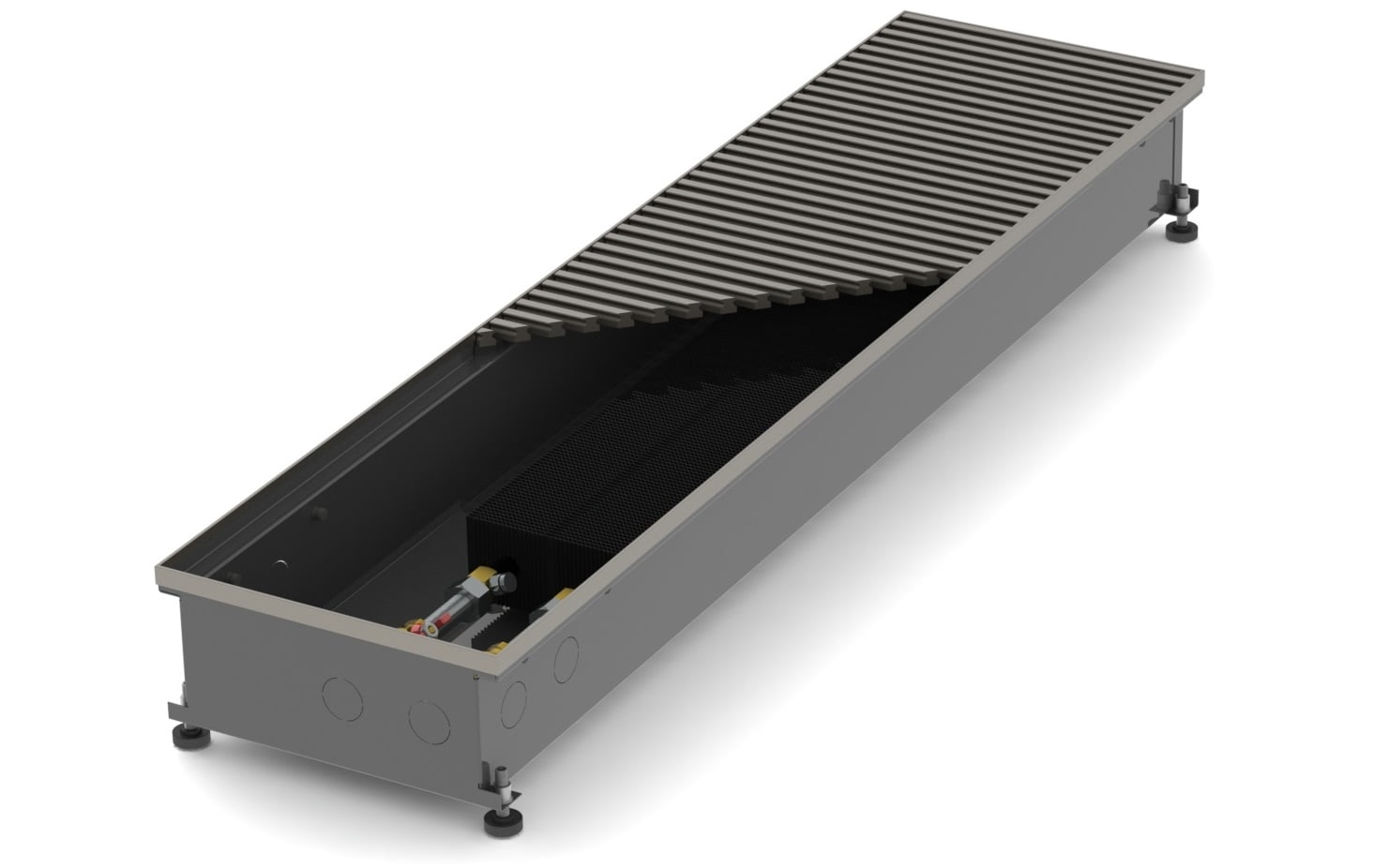
SC110 Convector - without fan
Product Details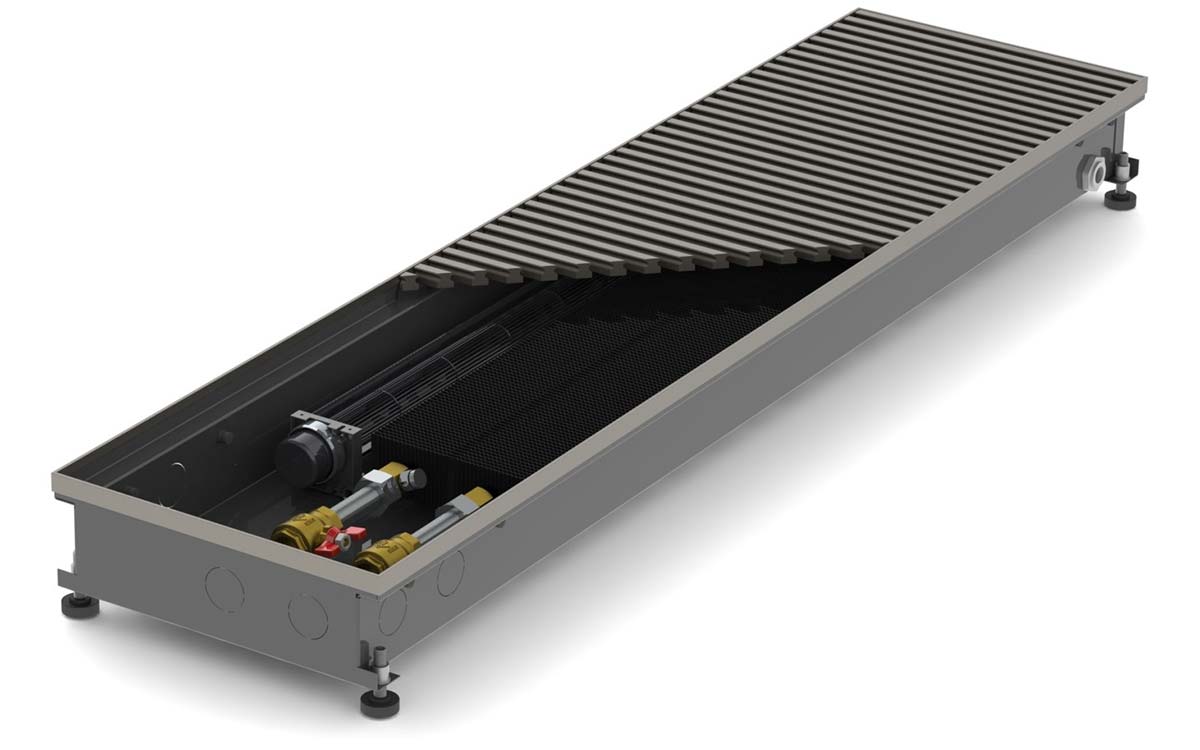
LC65 Fan-Assisted Convector
Product DetailsLC80 Fan-Assisted Convector
Product Details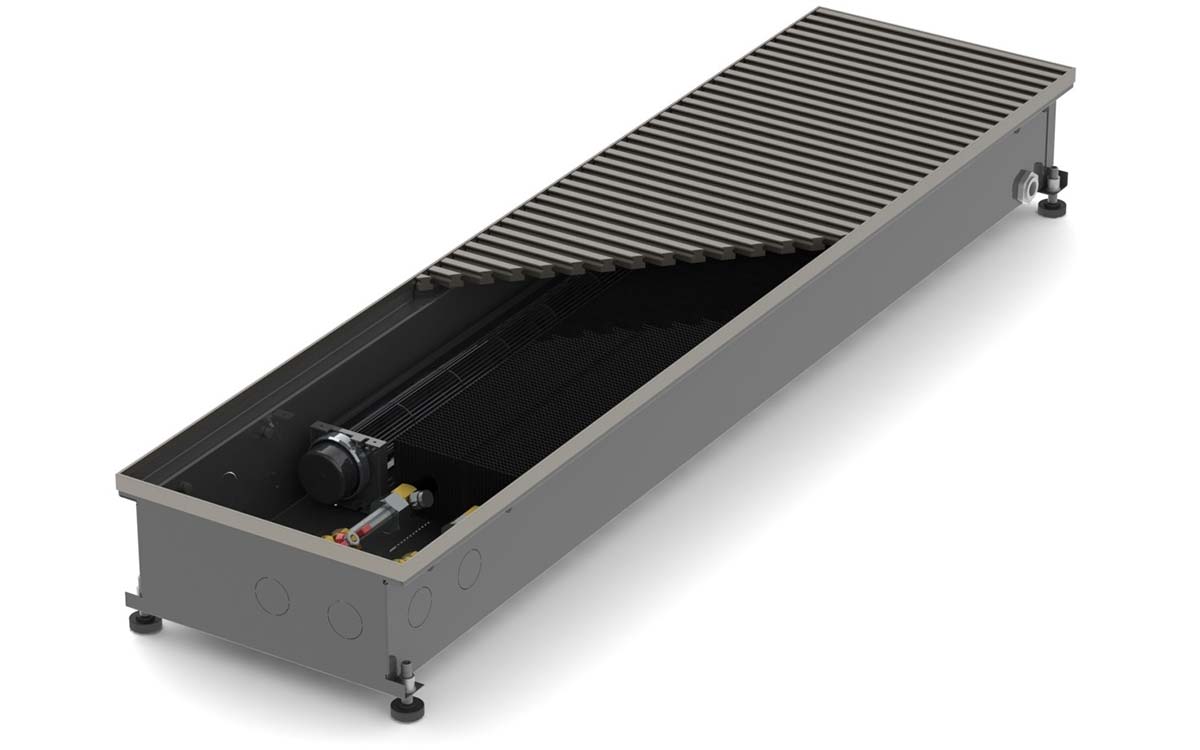
LC110 Fan-Assisted Convector
Product Details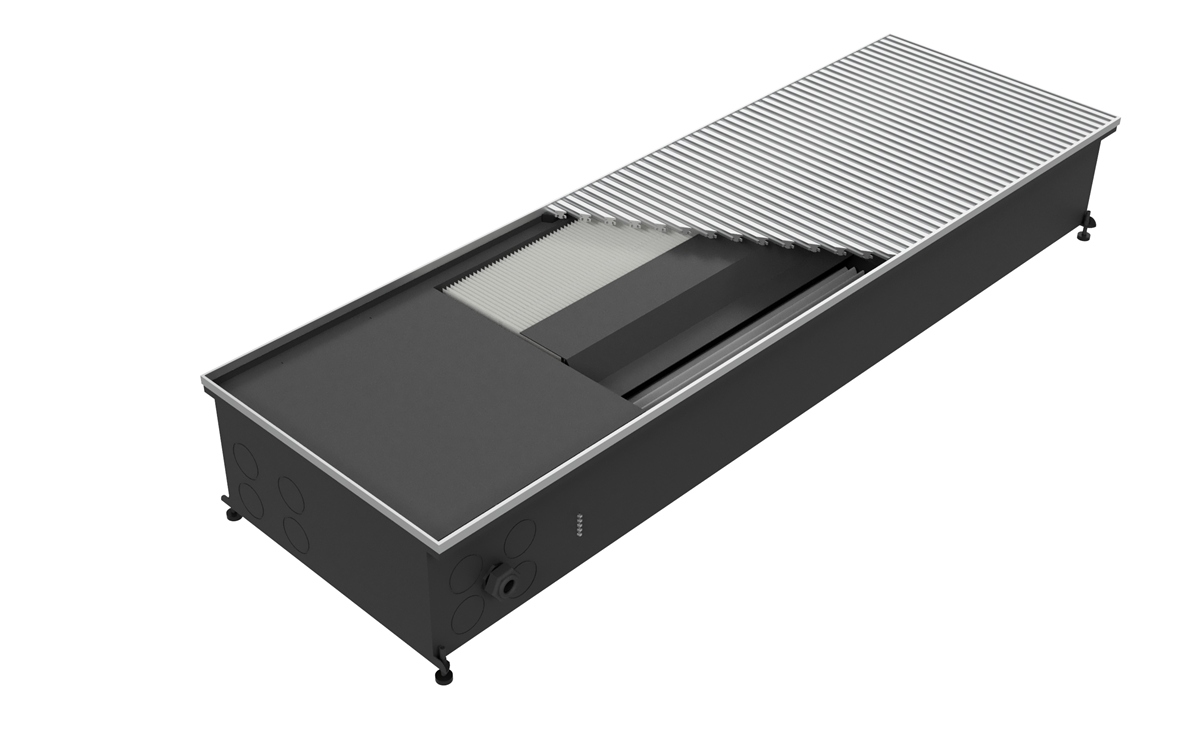
LK140 Heating/Cooling Convector
Product Details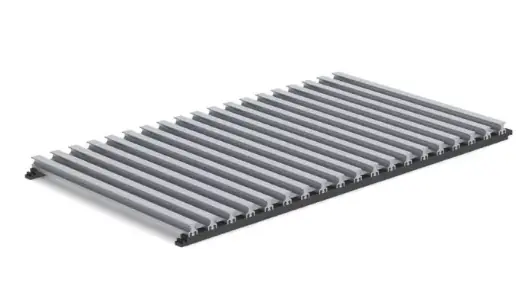
Walkable Grilles
Product Details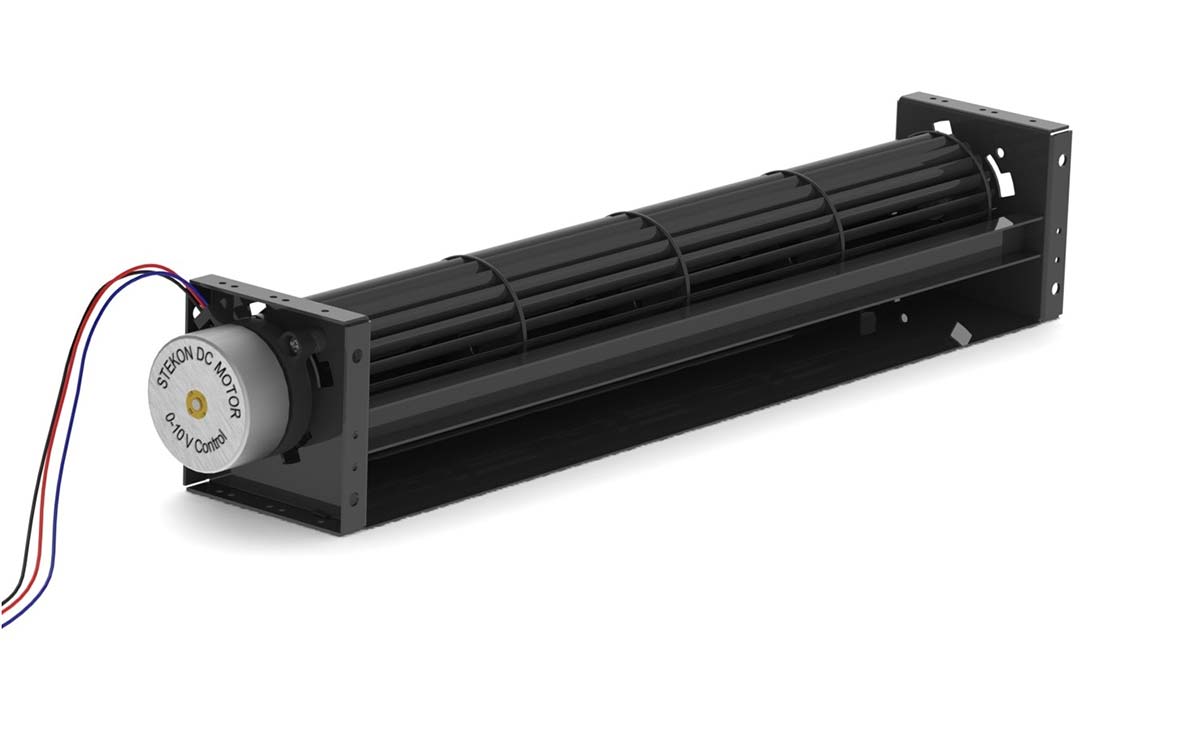
Tangential Fans
Product DetailsVideos
STEKON Floor Convector
STEKON floor convectors are designed to provide a high level of thermal comfort in spaces with large exterior glazed surfaces. This comfort is achieved by creating a thermal barrier in front of cold glass surfaces. At the same time, this helps prevent possible condensation on the glazing. The convectors provide warm air circulation through heat exchange with hot water, either by fan-assisted or natural convection.
LC Series fan-assisted convectors operate at a safe voltage of 24 V DC. The integrated EC fans have very low energy consumption and automatically adjust their speed according to the room temperature based on signals received from the thermostat or building automation system. They are compatible with 0–10 V control signals.
Advantages of STEKON Floor Convectors
Fan-assisted and natural convection models
Economical and safe operation with 24 V DC supply voltage
One-piece convector lengths from 1000 mm to 3000 mm
Convector height options of 65, 80 and 110 mm
Various grille and frame options
Special coating options
Ultra-quiet cross-flow fans
Smooth and continuous 0–10 V speed control
Easy installation thanks to the Plug & Play connection box
Convector coils tested according to EN 442-2
Floor Convector Selection Recommendations
Determine whether the convector will be used as the primary heat source, a secondary heat source, or as a thermal barrier.
Determine the total heat loss of the room and how much of this load will be covered by the convector.
Check whether a natural convection model can provide the required heating capacity and whether fan assistance is necessary.
Consider the available installation length and cross-sectional space when sizing the convector.
Determine a suitable location for the transformers required for fan-assisted convectors with 24 V DC output.
Determine a suitable location for the room thermostat.
Make the necessary provisions in the installation for water connections and electrical wiring.
Construction and Materials
Painted galvanized steel casing
Aluminium grilles and frames
Aluminium-fin, copper-tube heat exchanger
Black-painted galvanized steel fans
Accessories and Special Variations
0–10 V or on/off control options
Grilles parallel to either the long or short side
Anodized or RAL-painted grilles
Angled corner connection sections
Water connection from either the short or long side
Frequently Asked Questions About Floor Convectors
1. How soon can I receive the convectors after placing an order?
Depending on the order quantity, delivery is typically completed within approximately 3–4 weeks.
2. Where can I collect the convectors?
You can collect the products from our factory in Esenyurt, Istanbul. Alternatively, upon request, we can arrange transportation and deliver the products to your address for an additional freight charge.
3. Are the convectors covered by a warranty?
STEKON floor convectors are supplied with a 2-year warranty for the casing, heat exchanger and grille.
For fan-assisted models, the EC motor tangential fan assemblies are covered by a 5-year warranty, which is above the industry standard.
The warranty is valid provided that the product is installed correctly and periodic maintenance is carried out.
4. Can I use the convectors with my domestic boiler?
Yes. Similar to conventional radiators, the convectors are suitable for use with hot-water systems such as domestic boilers, central boilers and central heating systems.
5. How are the convectors installed?
The convectors are installed in front of glazed surfaces, either recessed into the screed or integrated into raised-floor systems.
Before the screed is poured, channels of suitable dimensions must be prepared. If the screed already exists, channels can be opened by removing the existing screed. The dimensions of the installation channel should be at least 5 cm larger than the convector on all sides.
The unit is levelled using the height adjustment screws and then fixed to the floor. Water connections are made to the internal heat exchanger using flexible hoses. Electrical connections are completed according to the specified wiring instructions.
The screed is then poured around the installation channel so that the convector remains embedded within the floor construction. The final screed level must take into account the thickness of floor finishes such as parquet, carpet, ceramic or marble.
After all finishing work has been completed, the protective cover on the unit is removed and the decorative grille supplied with the convector is placed on top.
Detailed installation video:
6. How are the hot-water connections made?
Unless otherwise specified when ordering, the water connections are located on the left-hand side of the unit, when viewed from inside the room towards the convector.
As with radiator connections, the hot-water supply and return pipes coming from below the floor are connected to the heat exchanger inside the convector using flexible hoses.
Water connections can be made from either the short side or the long side of the convector.
7. What do I need to operate the convectors?
For natural convection convectors, completed water connections are sufficient for operation.
If required, an on/off valve can be installed inside the unit or on the manifold and controlled locally via a room thermostat.
Alternatively, the complete hot-water system, such as the boiler or central heating plant, can be switched on or off so that all connected convectors operate simultaneously without the need for electrothermal valves.
For fan-assisted convectors, in addition to the water connections, a 24 V power supply from a transformer and a 0–10 V control signal from the room thermostat are required. This means that a suitable transformer and thermostat must be provided. Electrothermal valves may also be used if required.
The use of thermostatic radiator valves is not recommended with floor convectors. Since such valves sense the surrounding air temperature, they cannot accurately measure the room temperature when installed inside the recessed convector channel.
8. What voltage do STEKON fan-assisted convectors operate at?
STEKON convectors operate at a safe voltage of 24 V DC.
This voltage is particularly suitable for these products because it significantly reduces electrical safety risks in the event of water leakage or during maintenance and servicing in residential or office environments.
9. What are the sound levels of fan-assisted convectors?
The fans used in STEKON floor convectors are high-technology EC motor fans specifically developed for this type of application. They provide proportional speed control across a wide operating range.
Even at maximum speed, the convectors operate at very low sound levels. At a distance of 1 metre, the typical sound pressure level is approximately 25–32 dBA.
For comparison, 30 dBA is approximately equivalent to a quiet library or soft whisper.
10. Where should convectors be installed in a room?
Although the ideal position may vary depending on the application, the most suitable location is generally directly in front of glazed surfaces.
The convectors create a warm-air barrier in front of the glazing, helping to prevent cold-air downdraughts and reduce the effect of cold radiation.
They provide comfortable heating without obstructing the view through the glass façade.
11. Why should I choose floor convectors instead of conventional radiators?
The most effective location for a heating unit is in front of glazed surfaces because a large proportion of heat loss occurs through windows and façades.
The increasing use of floor-to-ceiling glazing in modern residential and commercial spaces often forces conventional radiators to be installed on other walls, resulting in less efficient heat distribution.
Floor convectors are increasingly replacing conventional radiators in modern heating systems because they can be installed flush with the floor without obstructing the view, offer an elegant and discreet appearance, and provide efficient heating and improved comfort in front of glazed façades.
12. Can the convectors be integrated with smart-home systems?
Yes. The convectors can be fully integrated with smart-home and building automation systems.
The valve position and fan speed can be controlled according to the set room temperature.
Remote access via a smartphone can also be provided depending on the automation system.
For system integration, technical support from our engineers is recommended.
13. Can the convectors be supplied in different colours?
Unlike many standard products, STEKON floor convectors use decorative grilles developed and manufactured specifically to provide both high durability and an improved architectural appearance.
The grilles can be supplied in aluminium or bronze anodized finishes. They can also be powder-coated in the required colour to match the floor finish or window frames.
14. Do convectors require maintenance, and how should they be cleaned?
Maintenance for both fan-assisted and natural convection convectors mainly consists of removing accumulated dust.
The decorative grille can be lifted and dust or debris inside the unit can be removed periodically using a vacuum cleaner.
Regular cleaning also helps maintain the efficiency of the convector.
It is recommended that this cleaning be carried out approximately every 6 months, preferably during seasonal transitions between summer and winter.
15. Do convectors dry out the air in the room?
This is not specific to convectors and may occur with all types of heating systems.
The humidity level in a space heated by convectors is not significantly different from that in a room heated by radiators or air-conditioning systems.
16. Do fan-assisted convectors circulate dust?
The airflow rates of STEKON fans are optimized specifically for floor-convector applications, which minimizes the possibility of dust being lifted and circulated within the room.
Provided that the units are cleaned and maintained periodically, dust circulation should not present a problem.
17. How can I determine which convector model is suitable for my home?
Every indoor space has different heating requirements depending on its individual conditions.
Once the required heating capacity has been determined, the output of the selected convector can be calculated using the Smartstep selection software to verify that the unit is suitable.
Another important limitation is the available screed depth.
The convector height must be selected according to the available floor construction depth. The heating capacity should then be verified for the selected model.
As a general recommendation, the total convector length should be approximately equal to the width of the glazed surface.
18. If the fan fails, can it be replaced without breaking the floor?
Yes. There is no need to break or remove the floor.
All service operations on STEKON floor convectors are carried out from above after removing the decorative grille.
The walkable grille installed on top of the unit is not permanently fixed and can be lifted by hand.
Once the grille is removed, the tangential fan assembly, electrical connection box and heat exchanger are directly accessible.
The fan assembly can be disconnected through its plug-in connection and replaced with a new unit.
The replacement typically takes approximately 1 hour and does not require any intervention to the screed, floor covering or water installation.
For a product installed permanently within the floor structure, this is one of the most important design considerations and should always be checked before purchase.
19. Which convector model is suitable for my available screed depth?
The first limitation in model selection is the clear depth of the channel in which the unit will be installed.
STEKON offers different casing heights. The most suitable model can be determined as follows:
Model | Casing Height | Required Clear Channel Depth | Typical Application |
|---|---|---|---|
LC65 (fan-assisted) | 65 mm | 70 mm | Limited screed depth, renovation projects |
LC80 (fan-assisted) | 80 mm | 85 mm | Most common choice for residential and office applications |
SC80 (natural convection) | 80 mm | 85 mm | Supplementary heating, low heat-loss applications |
LC110 (fan-assisted) | 110 mm | 115 mm | High heating-capacity requirements, large glazed façades |
SC110 (natural convection) | 110 mm | 115 mm | High-capacity natural convection applications |
LK140 (heating/cooling) | 140 mm | 150 mm | Projects requiring both heating and cooling |
The calculation can be made as follows:
Total floor construction depth = Casing height + Adjustment allowance + Floor finish thickness
Adjustment allowance: The unit is installed on height-adjustment screws. A minimum allowance of 5 mm should be provided for levelling.
Floor finish: The upper surface of the grille must be flush with the finished floor level. Typical allowances are 12–15 mm for parquet, 10–12 mm plus adhesive for ceramic tiles, and 20–30 mm for marble.
Channel width: The installation channel should be at least 5 cm wider on each side than the convector.
20. Is a natural convection convector sufficient for my room, or should I use a fan-assisted model?
The decision depends on the room heat loss and the available installation length in front of the glazing.
A practical guideline is as follows:
Natural convection models (SC Series) are generally sufficient when:
The convector is used as a secondary heat source and another heating system, such as underfloor heating or radiators, is already installed.
The main objective is to reduce cold downdraughts and prevent condensation in front of glazed surfaces.
The room heat loss is relatively low and the available glazing length is sufficient to provide the required heating output.
Completely silent operation is required, for example in bedrooms.
Fan-assisted models (LC Series) are generally required when:
The convector is the primary heating source for the room.
The available length in front of the glazing is not sufficient for a natural convection unit to provide the required capacity.
The system operates with low-temperature water, such as a heat pump system at 45/35 °C.
Rapid room heating is required. Fan-assisted units can raise the room temperature significantly faster.
Capacity comparison:
With the same casing dimensions, a fan-assisted unit can provide approximately five times the heating capacity of a natural convection unit.
At 75/65/20 °C operating conditions:
SC80-240: approximately 227 W per metre
LC80-240: approximately 1180 W per metre
Selection steps:
Calculate the total heat loss of the room in watts.
Determine how much of this load will be covered by the convector.
Measure the available installation length in front of the glazing. It is recommended that the total convector length should approximately match the width of the glass surface.
If available length × heating output per metre of the natural convection model ≥ required heating capacity, a natural convection unit is sufficient.
If this is insufficient, consider a deeper casing such as a 110 mm model or select a fan-assisted unit.
21. Are the heating capacities published for STEKON floor convectors verified by independent laboratory testing?
Yes.
STEKON LC65, LC80, LC110, LK115, LK140, SC80 and SC110 floor convector models have been tested by independent laboratories.
The published heating and cooling capacities are based on performance tests carried out in accordance with the relevant standards.
LC80 and LC110 fan-assisted floor convectors:
Heating capacity varies depending on unit length, casing width, water inlet and outlet temperatures, and fan speed. The tests were carried out in accordance with EN 16430 at the HEATEST laboratory, accredited according to ISO/IEC 17025 (Test Report No. 017/2026). The capacities published in STEKON catalogues are identical to the independently measured test results.SC80 and SC110 natural convection floor convectors:
Heating capacity depends on unit length, casing width and water inlet/outlet temperatures. Performance data is based on tests carried out at ELBA Laboratories in accordance with TS EN 442-2 / March 2015 (Test Report No. 2022-94).LK115 fan-assisted heating and cooling convector:
The unit is equipped with a stainless-steel drain pan, high-capacity heat exchanger and Ø60 mm tangential fans. Heating and cooling performance has been independently tested according to EN 442-2, EN 16430-2 and EN 16430-3 at the HEATEST laboratory, accredited according to ISO/IEC 17025 (Test Report No. 018/2026).LK140 fan-assisted heating and cooling convector:
The unit is equipped with a stainless-steel drain pan, high-capacity heat exchanger and Ø60 or Ø80 mm tangential fans. Heating and cooling performance has been independently tested according to EN 442-2, EN 16430-2 and EN 16430-3 at the HEATEST laboratory, accredited according to ISO/IEC 17025 (Test Report No. 019/2026).LC65 fan-assisted floor convector:
The model's performance and capacity data are also based on independent accredited laboratory testing.
These tests ensure that the capacities stated in STEKON catalogues are based not only on theoretical calculations, but on actual performance measurements obtained under standardized laboratory conditions.
When selecting a unit for a project, the relevant model dimensions, water temperature regime and, for fan-assisted models, operating fan speed should all be taken into consideration.