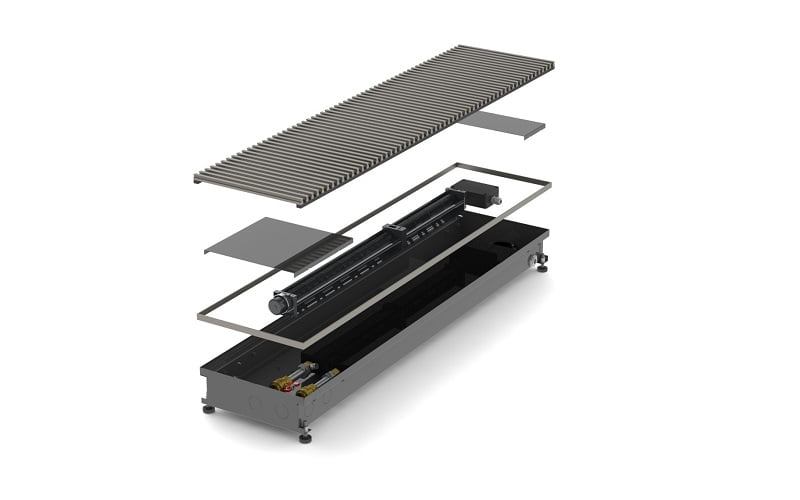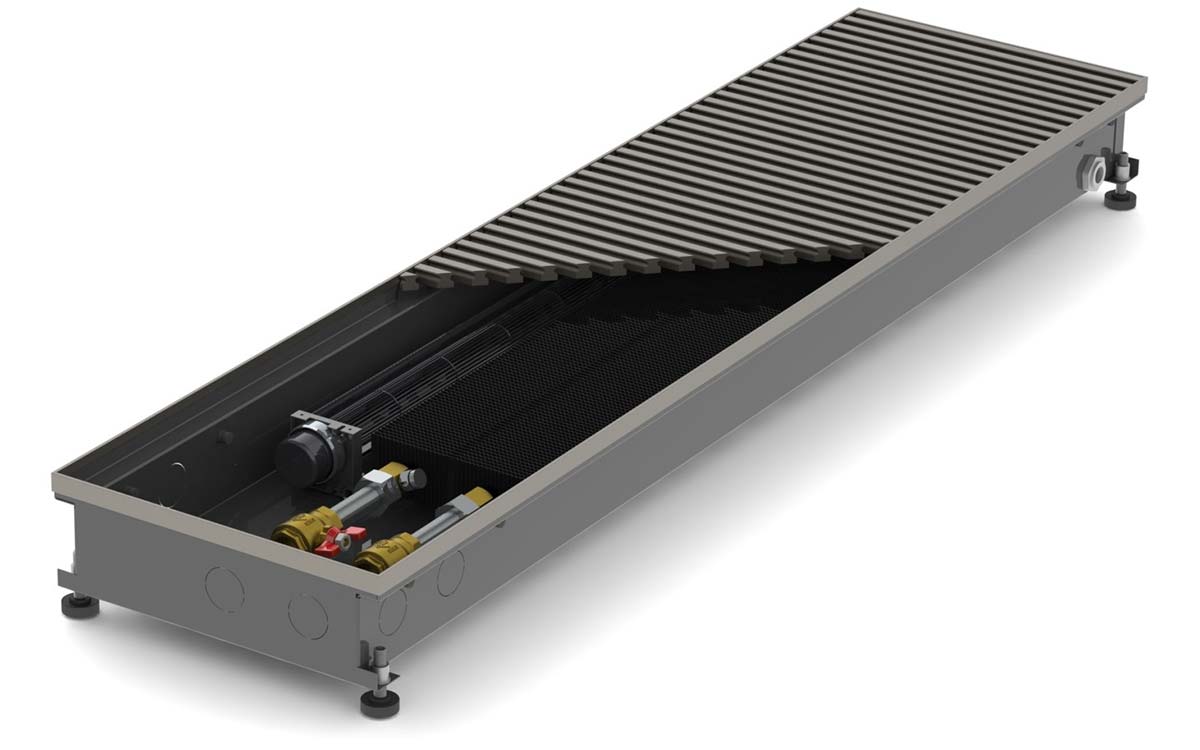
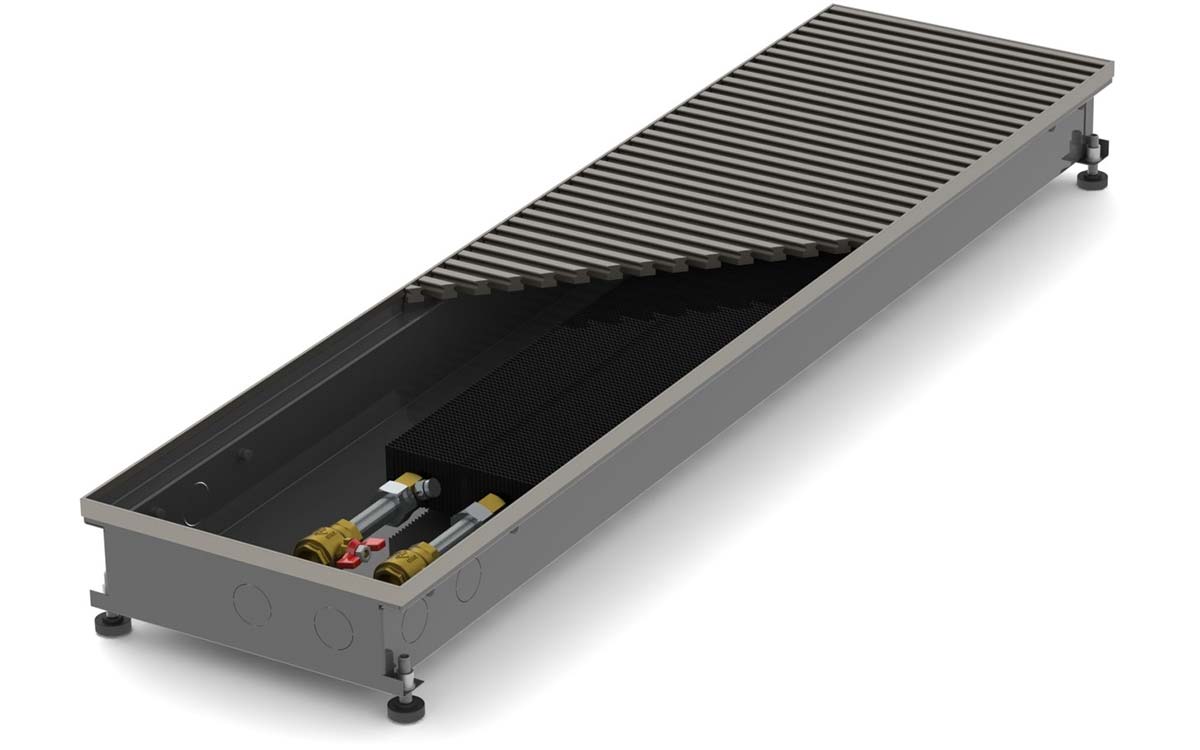
SC80 Convector - without fan
SC80
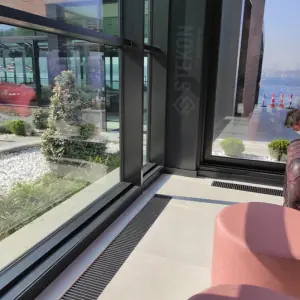
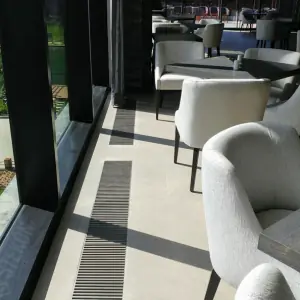
STEKON trench convectors are designed to provide high thermal comfort conditions in environments with large external glass surfaces. This comfort is achieved by creating a thermal curtain in front of the cold glass surfaces. At the same time, it prevents a possible condensation problem on the glass surface. Convectors provide hot air circulation through hot water-sourced heat exchange, either fan-assisted or via natural convection.
The heating performance values of the SC80 Fanless Trench Convector have been tested by independent test laboratories according to TS EN 442-2.

With Smartstep Selection, you can make all product selections quickly and easily and print out the technical outputs of the projects you have created.
Catalogues & Tools
Technical Dimensions
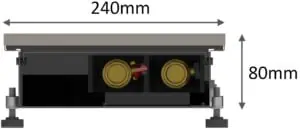



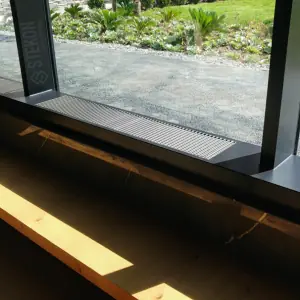
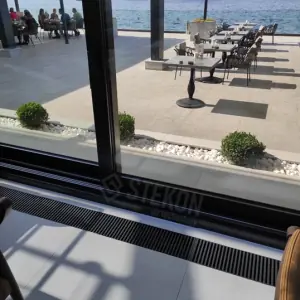

The heating capacity of the STEKON SC80 fanless (natural convection) trench convector varies depending on the unit length, casing width, and water inlet/outlet temperatures. The values below are based on tests carried out at ELBA Laboratories in accordance with TS EN 442-2 / March 2015 (Test Report No: 2022-94).
Model | Casing Height | Casing Width |
|---|---|---|
SC80-200 | 80 mm | 200 mm |
SC80-240 | 80 mm | 240 mm |
SC80-300 | 80 mm | 300 mm |
STEKON SC80 Fanless Trench Convector — Heating Capacity (W)
Water regime: 80/60 °C, room temperature: 20 °C
Length (mm) | SC80-200 | SC80-240 | SC80-300 |
|---|---|---|---|
1000 | 143 | 188 | 215 |
1250 | 197 | 254 | 290 |
1500 | 251 | 321 | 367 |
1750 | 306 | 387 | 443 |
2000 | 360 | 454 | 520 |
2250 | 414 | 520 | 597 |
2500 | 468 | 588 | 673 |
2750 | 522 | 653 | 750 |
3000 | 577 | 722 | 826 |
STEKON SC80 Fanless Trench Convector — Heating Capacity (W)
Water regime: 70/50 °C, room temperature: 22 °C
Length (mm) | SC80-200 | SC80-240 | SC80-300 |
|---|---|---|---|
1000 | 103 | 126 | 146 |
1250 | 142 | 171 | 198 |
1500 | 181 | 216 | 250 |
1750 | 220 | 261 | 302 |
2000 | 259 | 305 | 354 |
2250 | 298 | 349 | 407 |
2500 | 337 | 396 | 458 |
2750 | 376 | 439 | 511 |
3000 | 415 | 485 | 563 |
Question: Is a fanless convector sufficient for my room, or should I choose a fan-assisted model?
This is the first and one of the most important decisions when selecting a trench convector. The answer depends on the role you expect the convector to perform.
A fanless convector transfers heat by natural convection — in other words, by allowing warm air to rise naturally. In a fan-assisted model, air is forced across the heat exchanger, significantly increasing the rate of heat transfer.
The difference between the two is not simply a minor performance difference; it is a difference in output scale.
Fan-assisted vs. fanless capacity under the same conditions
(2000 mm length, 240 mm width, Δt = 50 K)
Model | Capacity | Ratio |
|---|---|---|
SC80-240 (fanless) | 454 W | 100% |
LC80-240 (fan-assisted, Speed 1) | 1,828 W | 403% |
LC80-240 (fan-assisted, Speed 3) | 2,359 W | 520% |
A fan-assisted unit of the same size provides approximately 5 times the heating capacity of the fanless model.
In terms of output per metre, the SC80-240 provides approximately 190–240 W/m, while the LC80-240 provides approximately 1,180–1,255 W/m.
A fanless SC series convector may be sufficient if:
The convector is used as a secondary heat source and the room is also heated by underfloor heating, radiators, or air-conditioning
The main purpose is to prevent cold downdraught and condensation in front of glazed façades
The room has a low heat loss and the available length in front of the glazing is sufficient to provide the required capacity
An electrical connection is not desired or is not available
Completely silent operation is required
A fan-assisted LC series convector is recommended if:
The convector is the room's primary heat source
The available length in front of the glazing is insufficient to achieve the required capacity with a fanless unit
The system operates at a low water temperature, such as with a heat pump
Rapid room heating is required
Practical selection rule:
Calculate the total heat loss of the room (W).
Determine how much of this load is to be covered by the trench convector.
Measure the available installation length in front of the glazing.
If available length (m) × 220 W ≥ required output, a fanless unit may be sufficient.
If this is not sufficient, consider, in order, a wider casing (300 mm), a deeper casing (110 mm), or a fan-assisted model.
Example: In a living room with 3 metres of available glazing length where the trench convector is expected to provide 1,500 W, a fanless unit would provide approximately 700 W and would therefore be insufficient.
A fan-assisted LC80-240 of the same size would provide approximately 3,700 W, comfortably covering the required load.
Question: Can a fanless convector be used with a heat pump?
Only to a limited extent. Fanless trench convectors are generally not recommended for heat pump systems.
With natural convection, heat transfer is strongly dependent on the temperature difference between the heating water and the room air. As this temperature difference decreases, the heating capacity drops rapidly.
The SC80 test data clearly demonstrates this effect: when the water regime is reduced from 80/60 °C to 70/50 °C, with a room temperature of 22 °C, the heating capacity decreases by approximately 33%.
When the system operates at 55/45 °C, a typical temperature range for heat pump systems, the reduction becomes significantly more pronounced, and the unit is generally no longer practical as the primary heat source.
The situation is different with the fan-assisted LC series. Thanks to forced airflow across the heat exchanger, the LC80 retains approximately 58% of its heating capacity at a 55/45 °C water regime.
Therefore:
For heat pump systems, the fan-assisted LC series is recommended.
The fanless SC series is better suited to systems operating with higher water temperatures, such as boilers and combi boilers.
In a heat pump installation, a fanless trench convector may still be used as a secondary heat source or as a thermal curtain in front of glazing, provided that realistic capacity expectations are applied.
Question: What are the advantages of a fanless convector compared with a fan-assisted model?
Although its heating capacity is lower, a fanless trench convector offers several specific advantages:
No electrical connection is required. There is no need for a transformer, thermostat, electrical wiring, or 24 V power supply. This reduces both installation cost and system complexity.
There are no moving parts. There is no fan, motor, or electronic control board that can fail. As a result, service requirements over the unit's lifetime are minimal.
Completely silent operation. The unit produces no operating noise. This makes it particularly suitable for bedrooms, libraries, meeting rooms, studios, and other noise-sensitive spaces.
No forced air movement. This can be an advantage in environments where dust circulation is a concern.
Lower initial investment cost.
Maintenance for both types mainly consists of removing the grille and cleaning accumulated dust from inside the unit. With the fanless model, this process is even simpler because there is no fan assembly to clean.