LK140 Heating/Cooling Convector
LK140
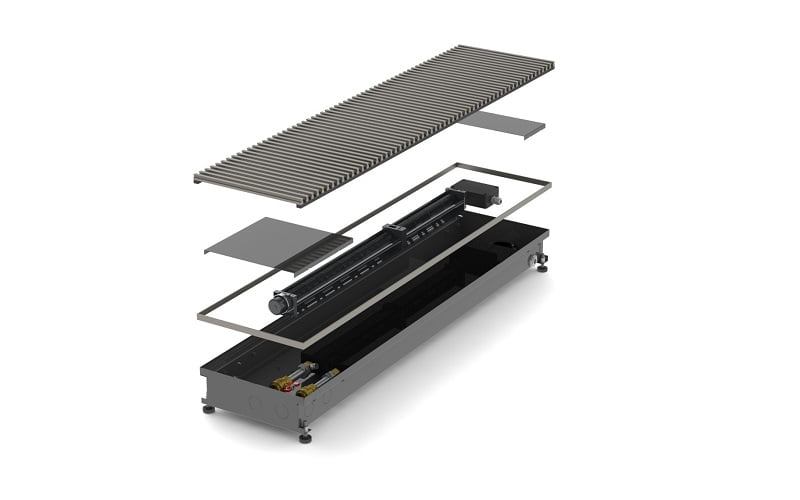
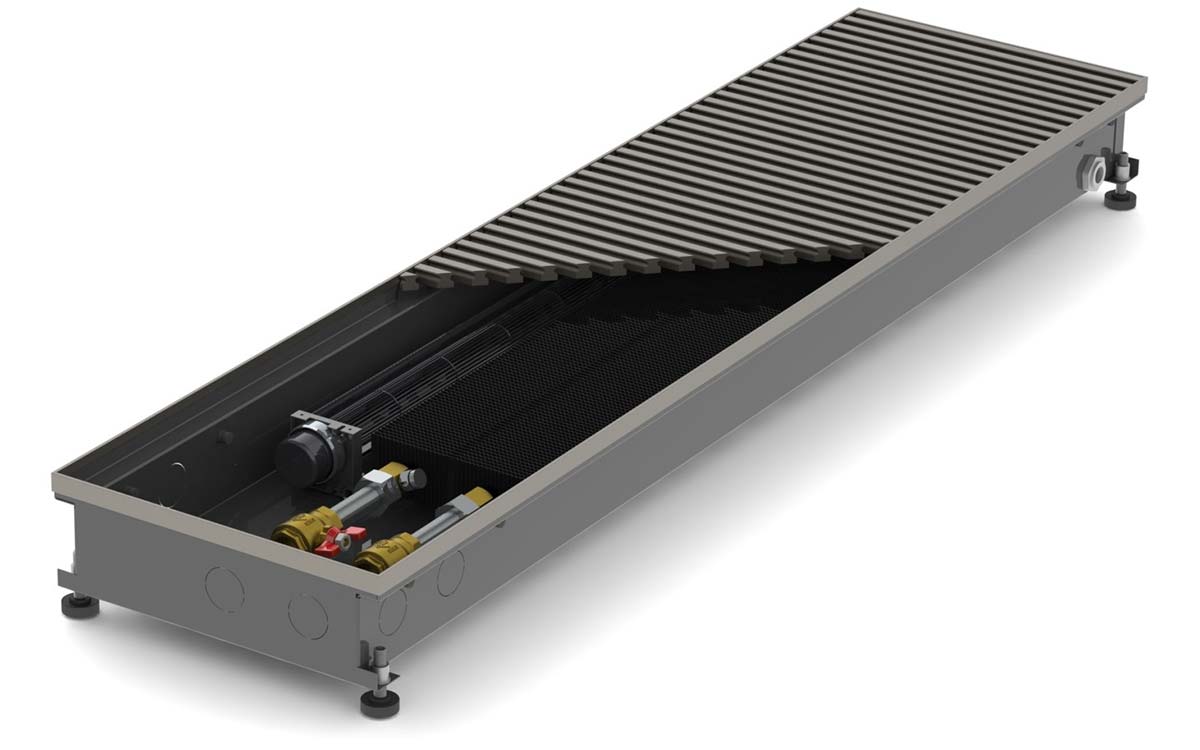
STEKON cooled trench convectors are designed to provide high thermal comfort conditions in environments with large external glass surfaces. Unlike heating-only convectors, the fan system draws air from the environment and directs it towards the glass. The cold air blown towards the warm glass surface absorbs the heat from the glass surface, and as the temperature difference with the ambient air increases, it settles back into the environment, conditioning the space by displacement. STEKON tangential fans, proven for their quietness and high flow output, are used for maximum comfort. They can be manufactured as 4-pipe or 2-pipe systems.
Cooling convectors with a stainless steel drain pan, an inclined high-capacity coil, and a Ø60 diameter tangential fan can perform both heating and cooling efficiently from a single unit.
LK series fan-assisted cooling convectors operate with a safe 24V DC voltage. Integrated EC fans have very low energy consumption and adjust their speed based on information received from a thermostat or building automation system, according to the ambient temperature. They are compatible with 0-10V input signals.
The heating and cooling performances of the STEKON LK140 trench convector have been determined through tests conducted in an independent test laboratory accredited to ISO/IEC 17025, in accordance with the EN 16430 standard applicable to trench convectors.
• Heating capacity: Tested according to EN 16430-2 standard.
• Dry cooling capacity: Tested according to EN 16430-3 standard.

With Smartstep Selection, you can make all product selections quickly and easily and print out the technical outputs of the projects you have created.
Catalogues & Tools
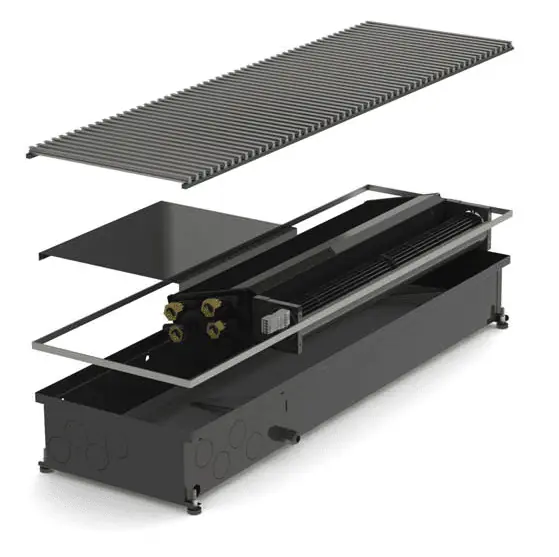
The STEKON LK series consists of fan-assisted trench convectors capable of providing both heating and cooling from a single unit. The main difference from the LC series, which is designed for heating only, is that in cooling mode the fan system draws in room air and directs it toward the glazed surface. The cooled air blown toward the warm glass absorbs heat from the surface, increasing the temperature difference between the air and the room. As the cooled air becomes denser, it descends back into the occupied zone, conditioning the space according to the principle of displacement cooling.
The units are equipped with a stainless steel condensate drain tray, a high-capacity heat exchanger, and Ø80 mm tangential fans. All convectors have been tested by independent accredited laboratories in accordance with EN 442-2, EN 16430-2, and EN 16430-3. The performance data are based on independent tests carried out by the ISO/IEC 17025 accredited HEATEST laboratory (Test Report No: 019/2026).
LK140
Technical Data
Property | Value |
|---|---|
Casing height | 140 mm |
Casing width | 340 mm |
STEKON LK140 — Heating Capacity (W)
Water regime: 75/65 °C, room temperature: 20 °C
Length (mm) | Speed 1 | Speed 2 | Speed 3 |
|---|---|---|---|
1100 | 1654 | 1930 | 2099 |
1250 | 2019 | 2356 | 2562 |
1500 | 2627 | 3065 | 3334 |
1750 | 3235 | 3775 | 4105 |
2000 | 3843 | 4484 | 4877 |
2250 | 4451 | 5194 | 5649 |
2500 | 5059 | 5904 | 6420 |
2750 | 5667 | 6613 | 7192 |
3000 | 6275 | 7323 | 7964 |
STEKON LK140 — Cooling Capacity (W)
Water regime: 7/12 °C, room temperature: 27 °C
Length (mm) | Speed 1 | Speed 2 | Speed 3 |
|---|---|---|---|
1100 | 773 | 941 | 1010 |
1250 | 941 | 1146 | 1230 |
1500 | 1221 | 1487 | 1596 |
1750 | 1501 | 1827 | 1961 |
2000 | 1781 | 2168 | 2327 |
2250 | 2061 | 2509 | 2693 |
2500 | 2341 | 2850 | 3059 |
2750 | 2621 | 3191 | 3425 |
3000 | 2902 | 3532 | 3791 |
Question: Should I choose the LK115 or the LK140?
The difference between the two models is not limited to their dimensions; their performance characteristics are also different. The LK115 has a width of 275 mm and a height of 115 mm and is manufactured only as a 2-pipe system. The LK140 has a width of 340 mm and a height of 140 mm and can be manufactured as either a 2-pipe or 4-pipe system.
Capacity comparison at the same length
(2000 mm, Speed 3)
Function | LK115 | LK140 | Difference |
|---|---|---|---|
Heating (75/65, 20 °C) | 4,522 W | 4,877 W | +8% |
Cooling (7/12, 27 °C) | 1,597 W | 2,327 W | +46% |
This difference is the key factor in model selection and remains consistent across the available lengths. The LK140 offers only a limited advantage in heating capacity, while its cooling capacity is approximately 50% higher.
If your primary requirement is heating and cooling is secondary: the LK115 is generally sufficient. Thanks to its slimmer casing, it can be used in projects with limited screed depth, with almost no compromise in heating performance.
If cooling is a critical requirement: the LK140 should be preferred. The difference becomes particularly important in glazed offices, winter gardens, and south- or west-facing spaces with high solar gains.
If simultaneous and independent heating and cooling are required: only the LK140 is suitable, because the 4-pipe option is available only with this model.
Question: What is the difference between a 2-pipe and a 4-pipe system, and which one should I choose?
In a 2-pipe system, a single water circuit is connected to the unit. Depending on the season, either hot water or chilled water flows through this circuit. The system is switched centrally to either heating or cooling mode, so simultaneous heating and cooling cannot be provided throughout the building. The piping arrangement is simpler and has a lower installation cost.
In a 4-pipe system, hot-water and chilled-water circuits are connected separately to the unit. Each room can therefore receive whichever mode it requires at that particular time — one room can be heated while another is cooled. This configuration is particularly suitable during transitional seasons, in buildings where north- and south-facing zones have different simultaneous loads, and in projects with high comfort requirements.
2-pipe | 4-pipe | |
|---|---|---|
Compatible model | LK115, LK140 | LK140 only |
Connection | 2 × G 1/2" | 4 × G 1/2" |
Simultaneous heating/cooling | No | Yes |
Piping cost | Lower | Higher |
Typical application | Residential, small offices | Office buildings, hotels, multi-orientation buildings |
A 2-pipe system is sufficient for most residential applications. For commercial buildings with different load profiles on different façades, the 4-pipe LK140 is recommended.
Question: What happens to the condensate water in a cooling trench convector? Will water accumulate in the floor?
No. LK series convectors are equipped as standard with a sloped stainless steel condensate drain tray designed specifically for this purpose. The casing includes a dedicated opening for the drain connection.
In cooling mode, condensation is unavoidable when the surface temperature of the heat exchanger falls below the dew-point temperature of the room air. This is not a fault of the unit; it is a physical consequence of cooling. The important point is that the condensate is collected and discharged safely. The sloped drain tray directs the condensate toward the drain outlet.
Points to consider during the design stage:
Since the unit is recessed into the floor, the condensate drain line should be designed with sufficient slope to allow gravity drainage. This means that the drain route below the screed must be planned in advance as part of the mechanical design.
The drain connection should be completed before the unit is installed and before the screed is poured. Any later intervention may require breaking the finished floor.
Unlike galvanized or painted sheet steel, a stainless steel drain tray does not corrode in a continuously damp environment. This material choice is especially important for a component installed below floor level, where access during the service life of the building may be limited.
Question: Can the LK series be used with a heat pump?
Yes. The LK series is particularly suitable for heat pump systems, and this compatibility is also stated in the product catalogue.
There are two main reasons for this. First, thanks to fan-assisted forced convection, an acceptable level of capacity can be maintained even at lower water temperatures — something that is much more difficult to achieve with natural-convection units.
Second, the same unit can operate with both hot and chilled water, allowing the heat pump to be used as a single system for both summer and winter operation. This eliminates the need for a separate cooling system.
Question: Trench convector or fan coil unit?
Functionally, the LK series performs the same basic task as a fan coil unit: it conditions room air using hot or chilled water. However, the way it is integrated into the building is completely different.
LK trench convector | Cassette / wall-mounted fan coil | |
|---|---|---|
Location | Recessed into the floor, flush with the finished floor | Ceiling- or wall-mounted |
Visibility | Only the grille is visible | The unit is visible |
Comfort at glazed façades | Operates directly in front of the glazing | Usually located away from the glazed surface |
Space loss | None | Uses ceiling height or wall space |
Electrical consumption | 10–30 W | Typically much higher |
Supply voltage | Safe 24 V DC | 230 V AC |
The difference in electrical consumption is particularly noteworthy. A 3000 mm long LK140 with three fans consumes only 30 W in total, while providing 7,964 W of heating capacity and 3,791 W of cooling capacity at maximum fan speed.
In addition, because it operates at a safe 24 V DC supply voltage, electrical safety is enhanced in an application where water leakage is a potential risk.
The LK series provides an alternative to conventional fan coil units in projects where ceiling height needs to be preserved, visible HVAC equipment is architecturally undesirable, and comfort needs to be provided directly in front of large glazed surfaces.
Question: Why is the air blown toward the glass in cooling mode?
This is one of the main operating differences between heating-only trench convectors and the LK series.
In heating mode, the objective is to create a rising curtain of warm air in front of the glazing to prevent cold downdraught and surface condensation.
In cooling mode, the operating principle is reversed: the fan draws in room air and directs the cooled air toward the glazed surface. The discharged cool air absorbs heat from the glass, increasing the temperature difference between the cooled air and the room air. As it becomes denser, it descends back into the occupied zone. In this way, the room is conditioned according to the principle of displacement cooling.
The advantage of this approach is that the glazed surface — one of the main sources of heat gain during summer — is targeted directly. The heat gain is addressed at its source before it spreads further into the room.